Notice! Notice!! Notice!!!

This blog was created but not updated for long time. Now we are updating this blog as well due to some reasons and its own advantages. For updated information of the Movement please visit www.worldamity.wordpress.com
Showing posts with label Article. Show all posts

Saturday, February 25, 2012

LUMBINI REBORN, NEPAL REBORN, BUDDHA REBORN


Posted by Ram Kumar Shrestha on February 25, 2012
[Lumbini-Kapilvastu Day Movement does not endorse the opinions of the author.]
NEPAL: THE NEW RAINBOW NATION?
By Gabriel Lafitte
Among Tibetans and their supporters worldwide, Nepal evokes dread. The news out of Nepal is invariably bad. The 20,000 Tibetan refugees in settlements are prisoners, unable to move freely, unable to obtain certification of their refugee status, unable to find employment or get an education, stigmatized and excluded. They may not publicly vote, protest or even hold religious celebrations of the birthdays of their most revered lamas.
China’s power over Nepal extends to equipping and financing the armed forces to patrol the border with Tibet, to apprehend Tibetans using the only route of escape. China’s ability to get the Nepali army to do its security work is aided by the willingness of Nepali politicians to be seduced by the largesse of China’s aid program, no strings attached, no accountability auditing of where the money went. From the outside, it seems that Nepal, riven by revolution, is agreed on only one thing, right across the spectrum, from Maoists to royalists: no-one likes the Tibetans.

Wednesday, February 8, 2012

Buddhism in the West


Posted by Ram Kumar Shrestha on February 8, 2012
By Kishore Sherchand (ksherchand@yahoo.com)
The religion of the future will be a cosmic religion. It should transcend personal God and avoid dogma and theology. Covering both the natural and the spiritual, it should be based on a religious sense arising from the experience of all things natural and spiritual as a meaningful unity. Buddhism answers this description. If there is any religion that could cope with modern scientific needs it would be Buddhism. ~Albert Einstein

Many in Nepal, my country of birth, have basic understanding of Buddhism.  I came to the US in 1979 and then again in 2006. I have tried to study how Buddhism is practiced in the US. I found people practicing Buddhism with great enthusiasm as compared to my fellow Nepalese back home. I have been more than a little disappointed with this observation in the past. Also, I put some sort of uncomfortable questions when we don’t dare to adore some of Buddha’s teachings.  The major reason for this subdued approach toward Buddhism has been the action of erstwhile rulers of Nepal, who tried to effectively banish Buddhism by expelling everyone who practiced Buddhism; and who threatened Buddhist monks and nuns with the choice of disrobing or leave the country.
Buddha’s ideas were based on his observation of human behavior starting with his experience when he ventured outside his palace and saw an old man, a sick man, and a dead man. Buddha taught that any human being can attain Buddhahood provided he or she follows the Eightfold Paths which are included in the Four Noble Truths. His teachings of the Four Noble Truths which included the Eight Fold Path are:
1.     There is suffering in the world.
2.     Suffering occurs because of too great an attachment to one’s desires.
3.     By eliminating the cause-attachment-you can eliminate suffering.
4.     There is a method to eliminating the cause, called the Eightfold Path, a guide to “right” behavior and thoughts. The Eightfold Path is a moral compass leading to a life of wisdom (right views, right intent), virtue (right speech, conduct, livelihood), and mental discipline (effort, mindfulness, concentration).

Saturday, February 4, 2012

कोरियामा मनोज गजुरेलको बिषयबस्तु भारतले गरेको बुद्धको जन्मस्थलबारे भ्रम


Posted by Ram Kumar Shrestha on February 4, 2012
 नेता राजा र राजनीतिले सिर्जना गरेका अनेक विकृतिलाई व्यंग्यको निसाना बनाउन खप्पिस लुम्बिनी-कपिलवस्तु दिवस अभियानका सांस्कृतिक दूत मनोजले यसपालि भने भारतले गरेको भगवान गौतम बुद्धको जन्मस्थलबारे भ्रमलाई विषय बनाएका थिए रामदेव बनेर ।
सोल -दक्षिण कोरिया, माघ १५ –  कोरियाली नयाँ वर्ष -सलनाल) को दिन यहाँ सर्वाधिक चिसो हुन्छ । परदेश पसेका नेपालीहरू भने भेटघाट र आत्मीयताको तातोमा रमाइरहेका छन् । जब गत शनिबार कोरियाली सञ्चारमाध्यमहरूले लुनार वर्ष मनाउन सोल क्षेत्रमा कार्यरत लाखौं कोरियालीहरू गाउँ र्फकदै छन् भनेर ट्राफिक जामसहितको समाचार प्रसारण गरिरहेका थिए, दशैताका काठमाडौं रित्तो भएजस्तै सोलमा पनि देखियो । यही मौकालाई नेपालीले भने आफ्नै देशका कला, संस्कृति र गीतसंगीतको मज्जा लिने अवसरका रूपमा सदुपयोग गरे । तुङदेमुन र यङदम्फोजस्ता क्षेत्र त मिनी नेपाल नै बने ।
आइतबार र सोमबार माइनस १२ डिग्रीको चिसो तापक्रम भए पनि तुङदेमुनमा रहेको मेट्रो रेलको ३ नं गेटमा नेपालीको भीड त्यतिकै थियो । तिनै नेपालीहरू कोरियाली नयाँ वर्ष सलनालको दुईदिने बिदामा आयोजना गरिएका सांस्कृतिक कार्यक्रमहरूमा दुःख, पीडा भुलेर नाचिरहेका थिए, हाँसिरहेका थिए ।

Saturday, July 30, 2011

What happened to the dream of a Buddhist Mecca?

Posted by Ram Kumar Shrestha on July 21, 2011
By Sanjaya Dhakal
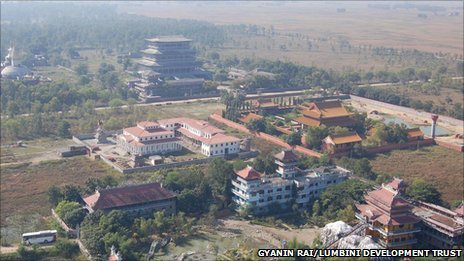
In the hot, dusty plains of south-western Nepal sits Lumbini, one of the holiest places for about 350 million Buddhists
Some monasteries have been built at Lumbini - but the master plan for its development remain incomplete
around the world.
Centuries ago a baby was born in Lumbini who went on to become the Buddha and many have long cherished plans that Lumbini could be developed into a Buddhist destination, comparable to Mecca, Islam’s holiest site.
But now buildings sit half-finished and empty fields lie neglected. More than a decade after Unesco designated it a World Heritage Site, Lumbini runs the risk of slipping into obscurity and promises to transform the site remain unfulfilled.
The most recent announcement was made by a Chinese group called the Asia Pacific Exchange and Co-operation Foundation, which declared it would raise $3bn (£1.9bn) to develop Lumbini by constructing airports, highways and hotels.
Continue reading the main story

LUMBINI

  • Located in the south-western Nepali plains 300km from Kathmandu and very close to India’s border
  • Birthplace of Siddhartha Gautama, probably around 566BCE, who later become the Buddha
  • Designated a Unesco World Heritage Site in 1997
  • Surrounded by large zone in which only monasteries can be built and no commercial premises
  • The site has a number of ancient ruins of monasteries, a sacred Bo Tree and a bathing pool – more is yet to be excavated
But both the Nepalese or Chinese government authorities claim to be in the dark about the grandiose scheme. The group insists that it is preparing a five-year plan to implement their idea of “developing Lumbini like a Mecca city”.
Yet it is unclear what stage the proposals are at and whether they will truly see the light of day.
Another Chinese organisation has proposed building a 100-metre-tall statue of the Buddha in Lumbini at a cost of more than $55m (£35m). The Nepal government has accepted this proposal but the groundwork is yet to begin.
Master planIt is frustrating for a number of Lumbini locals who pinned their hopes on the resurgence of their ancient and holy home.

Tuesday, June 14, 2011

Buddhism In America: What Is The Future?

Posted by Ram Kumar Shrestha on June 14, 2011
By Jaweed Kaleem
GARRISON, N.Y. — Backed by the nation’s largest Buddhist magazines and meditation centers, a recent invite-only gathering at an old monastery in this riverside hamlet north of New York City included a guest list of crimson-robed monks of Buddhism’s Tibetan line, tattooed “Dharma Punx,” professors and Japanese-influenced Zen Buddhists that read as a “who’s who” of Buddhism in America.
But the “Maha Council” (maha means “great” in Sanskrit) has created buzz and sparked soul-searching among members of the growing Buddhist religion in the United States for different reasons.
Who speaks for “western Buddhism,” many attendees and observers of last weekend’s event have asked, and how accurately and honestly are elder Buddhists passing on their knowledge to new generations?
What is the relation of U.S. Buddhists to those in India and other parts of Asia, where the spiritual practice was born from Hindu roots in the 5th century B.C.?

Friday, June 3, 2011

Buddha’s teaching of wisdom

Posted by Ram Kumar Shrestha on May 27, 2011
by Vickramabahu Karunaratne
( Colombo, Sri Lanka Guardian)The Government of Lanka says that on Wesak day this year, 2600 years after Buddha will be completed. Of course there are those who dispute the calculations of advisers to the government. In any case it must be pproximately true; and after so many years it is worth making an investigation into the fundamental teachings of Buddha. Buddha was probably the first human teacher to reject the idea of God or the Creator. Also, he rejected metaphysics and beliefs in super natural phenomena that existed in the religious practices at that time. In particular he rejected the idea of soul and the transmigration of soul towards an eternal life. In opposition to all that he put forward the idea of Dukkha as the fundamental truth of the universe. What is meant by Dukkha? Generally we hear, that Dukkha means suffering of the human subject. In that sense it is a universal truth confined to the human existence. However, what Buddha preached was a universal truth about the whole universe, or the total reality.
What is the objective meaning of dukkha? In the most general sense, dukkha means severe emptiness or negative nothingness. Does that mean continuous negation is the fundamental reality? Buddha often referred to a universal formula to depict the basic character of the reality: anitta- dukkha- anatma, meaning change-negation- lack of soul or substance. However Buddha was eager to explain the idea of dukkha referring to twelve varieties of happenings or movements. Rise and collapse, growth and decay, damage and recovery, unity of the opposite and separation of the equals, pressure and release, disturb and settle. In some places Buddha removed the last two sets and included these within damage and recovery.

In that case there were only eight movements included within dukkha. Inspite of such variations dukkha means all such possible severe happenings common to any thing and every thing within the universe. Impermanence, negation in nothingness- dukkha- is at the bottom of every thing. Physical world is a product of this self movement. Buddha said the four physical states, maha bhootha meaning general physical states, patavi or solidness, aapo or liquidness, vayo or gases, and thejo or fire are products of dukkha. In turn all physical things arise from four maha bootha.

Thursday, May 26, 2011

The mind and consciousness: Buddhist views vs Western science

Posted by Ram Kumar Shrestha on May 25, 2011

There is evidence that memories can exist outside a dead brain. It is reported that some transplant patients report uncanny experiences after receiving a donated kidney, liver or heart. Without knowing who the organ donor was, they began to participate in his memories.
by M.B. Werapitiya
(May 15, Colombo, Sri Lanka Guardian) Buddhism teaches the cleansing of one’s mind of its defilements arising from craving, anger and ignorance in order to see and comprehend things in their authentic form.
The cleansing is done with systematic forms of meditation whereby engaging awareness as a vital force a strong foundation of concentration is built to progress into knowledge, wisdom and insight. With the cleansing of the mind, the kammic energy that flows for one runs its course to a finish. With the cessation of kammic energy, rebirth comes to an end. Rebirth it is that brings disease, decay, death and the whole of man’s travail. Thus, cleansing one’s mind one fulfils the purpose of one’s earthly existence.

In Buddhism there is no difference between mind and consciousness. Consciousness meeting with sense faculties triggers off thoughts which lead to mental and bodily activities giving rise to feelings, sensations, perceptions and mental formations. Consciousness being foremost in the life of man getting to know it becomes essential. Here are some theories of notable scientists and philosophers on the subject.

According to Western medical science, consciousness is an attribute of living organisms – an attribute of life at a certain level of development.

The concept of consciousness as a state of awareness is a primary. It cannot be broken down any further or defined by reference to other concepts to which it can be reduced. Hence it is an irreducible primary. It means that at birth, man’s brain produces consciousness due to chemical reactions. On this basis it necessarily follows that consciousness must cease with death.

Friday, May 20, 2011

Buddha Jayanti: A Quest for Peace

Posted by Ram Kumar Shrestha on May 20, 2011
 
Rate This
Buddhism, which like western science had its own theory of causation, was born on Nepali soil from where it was exported to entire civilisations.
By Shanker Man Singh
We remember the heritage of Lord Buddha’s insight and faith. For more than 25 centuries, this has been the guiding spirit for millions of human beings. A holy land is nobody’s possession. Anybody can worship and the more people worship it, the more humanitarian it becomes. The story of the birth of Lord Buddha in the Lumbini Garden is an exceptionally beautiful one. Equally remarkable and memorable are his teachings. His teachings and never ending search for truth and the meaning of life and death has made him a source of immense spiritual inspiration and strength. According to “The Teaching of Buddha”, he taught himself to avoid the sin of killing any living creature, because he wished all people to know the blessedness of a long life. What a revolutionary message in a world where money rather than magnamity rules the day and where it is considered better to have something than to be something.
Buddha’s philosophy is an open philosophy or religion drawing the attention of people towards human sufferings, causes of sufferings and ways of getting through this impasse ultimately leading to salvation, the goal of all religions and philosophies. The ultimate aim of life should be the quest for freeing ourselves from the state of decay and inhalation for the good of mankind. Buddha has given us a message which is of permanent value, which is an eternal message, which is of timeless character but we are unworthy descendents of that Great Master.
According to “Teaching of Buddha”, he trained himself to remain free from all deception and double talk, because he wished all people to know the tranquillity of mind that would follow from speaking the truth.
The message of Lord Buddha has lost nothing of its strength and appeal through the ages. His deep respect for life and his concern for love and compassion have much in common with the values on which the whole world philosophy on peace is based.
Mankind owes a great deal to teachings of Lord Buddha, which have exerted a great influence throughout the ages. One of his famous statements is, ” Go forth for the benefit of the many, for the happiness of many, through compassion for the world. With this message spread around , the world will be a better place to live.” That was Lord Buddha’s first advice to his followers-advice that we consider as pertinent now as it was then. Indeed, in a very real sense, it symbolises the ideals upon which the United Nations and its global work are based.

Wednesday, May 18, 2011

Five Principles of Panchsheel

After attaining the enlightenment, Gautam Buddha went to the holy city of Benares and shared his new understanding with other fellows who became his disciples immediately. This was considered as the beginning of the Buddhist community. Till his death, Buddha with his band of disciples spread the gospel of the Dhamma among all the classes comprised of beggars, kings and slave girls.
The Basic Teachings of Buddha which are core of Buddhism are-

Source of Buddha's Teachings 
The Buddha's teachings have been reconstructed from stories, found mainly in the Sutta Pitaka. Although some stories describe his miraculous powers, others suggest that the Buddha tried to convince people through reason and persuasion rather than through displays of supernatural power. According to Buddhist philosophy, the world is transient (anicca) and constantly changing; it is also soulless (anatta) as there is nothing permanent or eternal in it. Within this transient world, sorrow (dukkha) is intrinsic to human existence. It is by following the path of moderation between severe penance and self-indulgence that human beings can rise above these worldly troubles. In the earliest forms of Buddhism, whether or not god existed was irrelevant.

Buddhist Teaching of Re-Birth The Buddha regarded the social world as the creation of humans rather than of divine origin. Therefore, he advised kings and gahapatis to be humane and ethical. Individual effort was expected to transform social relations. The Buddha emphasized individual agency and righteous action as the means to escape from the cycle of rebirth and attain self-realization and nibbana, literally the extinguishing of the ego and desire - and thus end the cycle of suffering for those who renounced the world. According to Buddhist tradition, his last words to his followers were: "Be lamps unto yourselves as all of you must work out your own liberation."

Monday, May 16, 2011

A brief description of Buddhism as I understand it.

Posted by Ram Kumar Shrestha on May 14, 2011


(Talk given to U3A University of Third age students in Swindon on 1-9-2008)


- Dr. Dharma Bhakta Shakya

In Buddhism there are three words used very frequently Buddha, Dharma and Sangha. I would describe them briefly so that you get some basic idea about Buddhism.

The Buddha – teacher

So who was Buddha? He was not born Buddha. He was born as a prince Siddartha Gautama in a place called Lumbini in present dayNepalmore than 2500 years ago. As a prince he lived in luxury but was not happy completely. He had a tendency to reflect on various aspects of life. Once he was found meditating deeply under a tree when he was only a little boy when every one else was enjoying one of the festivals. It was said that he had four visions

– a vision of an old man who was week due to old age,
– a vision of an ill man crying in pain
– a vision of a dead person taken to a cremation ground by his relatives and
– Finally he had a vision of a recluse (an ascetic) who had left home, who did not seem to have any worry in life and who was calm and composed.

These four visions had a great impact in him. He thought:

“Youth, the prime of life, ends in old age and man’s senses fail him when they are most needed. The hale and hearty lose their vigour and health when disease suddenly creeps in. Finally death comes, unannounced perhaps suddenly and unexpectedly without any invitation and puts an end to this brief span of life. Surely there must be an escape from this unsatisfactoriness, from ageing and death.”

Frequently he thought of leaving home and live a life of an ascetic.

So at the age of 29 he left the palace in search for a remedy for life’s universal ill. Initially he learned meditation from renowned teachers of the time but he was not satisfied from what he had learned. He then led a life of austerity with the belief that liberation was possible only by rigorous self mortification. He practised austerity for many years until he almost died. He realised that neither the life of luxury nor the life of austerity led him any where near his goal.

Thursday, March 17, 2011

The Tango of Ego and Soul

Dr. Judith Rich, Speaker, trainer, writer, coach, creator of Rx For The Soul: www.judithrich.com
Our lives unfold between the shores of the conscious and the unconscious. The conscious mind, when unexamined, reflects the agenda of the Ego, and concerns itself with matters of survival. It experiences and interprets events through the lens of its limiting perceptions; mainly, fear, and attempts to exert its power and influence through the use of the Will, the Ego’s instrument.
When the conscious or objective mind is in service to the Ego it is concerned with appearances, safety, comfort and maintaining the illusion of control. The Ego-driven mind wants to know: “How do I look? What will others think of me? Am I right? Am I loved/ good enough? Am I safe? Am I in control? How can I avoid pain?”
On a distant shore in a faraway land, the unconscious or subjective mind resides. Both personal and impersonal agenda take up residency there. The subjective mind houses our personally repressed memories as well as the transpersonal agenda of the universe. One could say the entire universe is housed within each one of us and it is only a dream, insight, reflection or imagination away!

Wednesday, March 16, 2011

Afghan Buddha Reconstruction Possible: Scientists

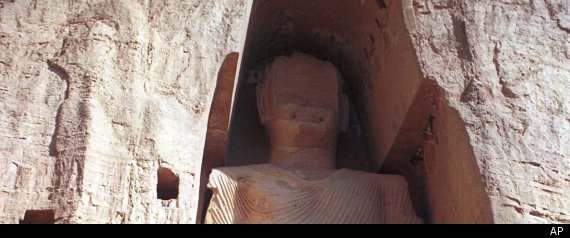
BERLIN — German scientists said Monday it may be possible to reconstruct one of two giant 1,500 year-old Buddhastatues dynamited by the Taliban in central Afghanistan 10 years ago, which prompted a worldwide outcry and left behind only towering cliff caverns.
Researchers have studied several hundred fragments of the sandstone statues that once towered up to 180 feet (55 meters) high in Bamiyan province, and found that they were once brightly colored in red, white and blue, said Erwin Emmerling of Munich’s Technical University.

Monday, June 21, 2010

Love, Spirituality and Four Noble Truths

Huffington Post

By Susan Pivar[1]

I have been a student of Buddhism since 1995, and the study and practice of dharma inform my actions, friendships and creative focus. When you become a Buddhist, part of the commitment is to take off the training wheels and do your best to put the dharma into play in all situations. It's no longer theoretical. It is your life. It's a fun, scary, and noble challenge.
When the Buddha became enlightened, the first thing he handed out was the four noble truths and upon becoming a Buddhist, they are your benchmarks.
  1. Life is suffering. (Doesn't mean "life sucks," by the way. More like, "life changes.")
  2. Suffering is caused by attachment. (Wanting things to be other than they are.)
  3. It is possible to stop suffering. (Phew.)
  4. There is an eight-fold path to liberate yourself from suffering, which includes such things as Right Speech, Right Action and so on.

Saturday, June 19, 2010

Buddhism – Fundamental to World Peace

By: Ram Kumar Shrestha
Even after entering into the 21st century – and a century of miracles of scientific achievements – still we have a question, “Are human beings happier than before?” Materialism as well as knowledge in the form of science and technology has contributed greatly to human welfare, however; it is considered to be responsible for deterioration in World Peace as well. Every single day our world spends more than $4 billion on war. However everyday, 20,000 children die of hunger, poverty and a lack of treatment and medicines and millions of people are suffering a lack of their basic needs like food, clean water, clothes and shelter. Nuclear power was developed in the name of establishing peace and now this is threatening the whole human race. Current existing amounts of nuclear power are enough to destroy not a single earth but dozens of equivalent earths. To dispose of this nuclear waste billions of dollars are needed that amounts to just 10-15% of the total cost of producing, maintaining and managing the nuclear industry. If only a certain percentage of these funds were used for the benefit of the people worldwide, struggling to have an education, minimum health care, food and housing a lot could be done. What will happen if the nuclear power will get into terrorists’ hand? This is today’s one of the biggest concerns for world leaders. So where are we now? Irrespective of interest everybody has to read, see, watch and listen to unwanted news full of violence, crime, rape, hunger, accident, war, epidemic, disaster etc in everyday life. However, dedicated persons and organizations are still optimistic for a better and peaceful globe.

Buddhist Insights for Accepting and Respecting Our Emotions

By Dzogchen Ponlop Rinpoche [1]
You would certainly recognize your signature on a piece of paper, but do you know your own emotional signature? We all have one. It’s our predictable way of reacting to situations. Your friends probably recognize your emotional signature better than you do. When you get into a fight with your partner, for example, they can predict just how it will go. They know if you’re likely to slam a door, storm out of the house, or call your mother. They know if you’ll be processing the argument for days or immediately shut down and clam up. How do they know so much? They know because they’ve seen it all before. Our behavior may seem spontaneous to us, but to those who know us, we’re not too surprising.
Why don’t we pay more attention to understanding our own patterns? We may have a solid financial plan worked out that will buy us a house and pay for our kids’ college and our retirement, but we don’t give much thought to getting the most benefit out of one of the most precious resources for happiness — our emotions. Often, we just leave it to chance.

Two Buddhist Truths for the Class of 2010

By Barun Soni
I was excited to be able to address Lafayette College’s Class of 2010 on the topic of “Awakening the Buddha Within.” This very well might be the first time in Lafayette’s history that the Baccalaureate Sermon was rendered from a Buddhist perspective, so I was thankful for this unique opportunity.
The Baccalaureate Sermon has a long and proud tradition at Lafayette College. On June 16th, 1895, the Reverend Dr. John Balcom Shaw of the West End Presbyterian Church in New York delivered the Baccalaureate Sermon to graduating students there.
He asked the students, “Would you plan for yourselves a great career? Is it your desire to begin a noble life-work?” In order to do this, he advised the graduating students to: “Know Thyself!”

Saturday, March 13, 2010

Lumbini

Lumbini was a beautiful amusement grove in about 7th century B.C. This horticulture spot was recreated by Koliyas of Devdaha and Sakyas of Kapilvastu. It was a place where Bodhisatwa Siddhartha Gautam put his first step on earth. The prince of the Sakya was born in Nepal in about 563 B.C. He was probably the greatest man ever to live in the Indian sub-continent in the whole of its remarkable history. He was born in orthodox Hindu family and raised accordingly and became the founder of the great religion which has spread far beyond the border of India.
According to Buddhist literature, Lumbini was addressed as Pradimoksha Vana and compared to the Chittalate Vana of lord Indra’s paradise in Heaven. Amid the cool shadow of thick Sal trees, the touch of the flowing breeze, and the fragrance of flowers and fruits, the bees of five colors hummed and people used to live with peaceful mind. This place is 22 km. west of Siddhartha Nagar and became a holy pilgrimage site after the death of Lord Buddha. Lord Buddha at his deathbed suggested his disciple Ananda to visit four places among which the first and the foremost place is Lumbini where he was born.

The Accumulate Stupa of Ramagrama

Nawalparasi is one of the most important district of Nepal from the Archaeological point of view. Besides many archaeological ruins, this district has an ancient stupa in Ramagrama, which according to many scholars is among the oldest stupa of Nepal. It is believed that this contains the relic of Buddha inside this stupa. Rama Grama is situated 5.3 km south east from Parasi, the head quarters of Nawal Parasi, south of Deurawa village, north of Billaspur, east of Ujjaini, west of Deau village and on the bank of the stream Jharahi. Considering its historical and archaeological importance the government has announced this area as Ramagram Municipality. The site is located in 830 41′ 05″ E and 270 29′ 55″ N on the height of 107 m from MSL1 .
According to Buddhist literature Sujat was the King of Saketa. He had have four sons and five daughters from his first wife. After her death the king married for second time. When the second queen gave birth to a son, she put her desire and also insisted the king to make her son the heir of the king and he must succeed the throne after the king.. Hence, the nine children of the first queen were forced to leave Saketa Kingdom.

NEPAL’S LUMBINI: WHERE THE BUDDHA WAS BORN

“…. Hida  Bhagavm Jateti Lumini Game“( The Lord  Buddha was born here in Lumbini Village). The full text of the inscription in English reads: “Twenty years after the coronation, Beloved-of-the-Gods, King Piyadasi (Ashok) visited this place and worshiped because here, Lord Buddha, sage of Sakyamuni was born”.[1]
By  B. K. Rana
General Background:
Lumbini, the present southwestern Nepalese Tarai, is one of the holiest Buddhist pilgrimages on the earth. Lumbini presents herself as a land of eternal peace and serenity. In fact it is a fountain of love, compassion, nonviolence and world peace also. The importance of this holiest pilgrimage is profound because Buddha was born here some 2600 years ago.
The young pregnant princess Maya Devi was on her way from Kapilvastu to Devadaha[1], her father’s home, as the time had come to deliver[2] baby Siddhartha Gautama – the future Buddha. The ‘Pradimoksha Van’ – Lumbini Garden – as so enchanting it was, she virtually could not resist ! She thought to stroll around the garden and take a bath also in ‘Pushkarini’ pond down there since the destination was not that far away. After the bath, she felt some pain in her stomach. Lo, she went into labour before reaching Devadaha! And a baby boy was born to become – the Enlightened One – the Buddha, the prince of peace, love and compassion. It was on the full moon day, Friday, Vaisakha of 623 B.C[3] .
As soon as the baby boy had entered the world, ‘he walked seven steps northwards on lotus petals; raised right hand forefinger and spoke, “Aggohamamsi Lokassa”[4] . At least two celestial figures began pouring water in his worship. In joy lotuses were thrown down from the heaven also’. This is what the Buddhist texts read and the Buddhists also believe in.

Wednesday, February 3, 2010

Kapilavastu Day as Part of the World Peace Movement

By Ram Kumar Shrestha
“We shall find peace. We shall hear the angels; we shall see the sky sparkling with diamonds.” (Anton Chekhov)  Undoubtedly a peaceful world is everybody’s yearning and dream and many philosophers and humanitarian activists are optimistic that we will get there, however; every day results make it seem that we are not making much progress.  The world peace mission has been complicated because of the divergence of people involved and their ways of thinking.  This suggests to us that we need to work in different ways to coordinate and cooperate with each other to achieve this goal. Although this mission is very difficult, it is not impossible if we are serious about bringing change.  As part of the World Peace Movement, Nepali intellectuals living in different countries decided to commemorate Kapilavastu, the birthplace of Gautam Buddha, Day as a global holiday in order to spread the peace message all over the world.  Gautam Buddha, has been revered as a Peace Ambassador who is more and more able to persuade his followers to work more seriously in the World Peace Movement. This day could be very important for researchers interested in collecting information about Buddha and Buddhism as there could be flood of information especially on Facebook, Twitter and other online medias.
Kapilavastu, located close to Lumbini, is considered a holy pilgrimage place for Buddhists since it is known to be the birthplace of the Lord Buddha. The result of years of excavation and research by numerous international teams has concluded that Kapilavastu is in Nepal.  UNESCO affirms the findings and has named Kapilavastu, and Lumbini as World Heritage sites.
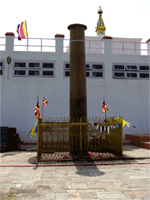
Originally, on December 1, 1896, Dr Anton Führer, a German archaeologist, had claimed to have discovered the Buddha’s birthplace when he found the Asoka Pillar at Lumbini.  Even though this site was originally discovered by Khadga Shamsher before Führer, Führer was credited with the find as he brought it to light and made it known to the international community. The Asoka Pillar is the most important evidence that proves that Buddha was born in Lumbini.  Therefore, we decided to celebrate December 1st as Kapilavastu Day.
Buddha taught that the world must be thought of in procedural terms and not in terms of things or substances. The Buddha advised viewing reality as comprised of dependently originated phenomena and Buddhists deem this approach to experience as avoiding the two extremes of Reification and Nihilism. This is the understanding that any phenomenon exists only because of the existence of other phenomena in an incredibly complex web of cause and effect covering past, present and future. Stated in another way, everything depends on everything else and this seems to be the basic of Newton’s law of Motion, ”To every action there is always an equal and opposite reaction”.  A human being’s existence in any given moment is dependent on the condition of everything else in the world at that moment, and in an equally significant way, the condition of everything in the world in that moment depends conversely on the character and condition of that human being. Everything in the universe is interconnected through the web of cause and effect; such that the whole and the parts are mutually interdependent. The character and condition of entities at any given time are intimately connected with the character and condition of all other entities that superficially may appear to be unconnected or unrelated.  All things, therefore, are conditioned and transient; they have no real independent identity and thus do not truly exist, although to ordinary minds this appears to be the case. All phenomena are therefore fundamentally flimsy and empty.  People with a broad mind are those who “see things as they are”, renouncing attachment and clinging, transforming energy of desire into awareness and understanding, and eventually transcending the conditioned realm of form becoming Buddhas.
Buddha Dhamma (Sanskrit:  Dharma) is not a religion, it does not give credence to a god or philosophy, but is the Law of Nature about how we should handle spirit, soul and body to bring them together in harmony and to begin to annul the ego and to stop any sorrow or affliction in our life!  This way we can learn to cultivate true happiness and not create a dependent happiness that is just for a fleeting moment eventually taking us back to the root of our problems.  It takes a lot of insight and deep reflection about us to see this reality.
Buddha counselled, “Believe nothing, no matter where you read it, or who said it, no matter if I have said it, unless it agrees with your own reason and your own common sense.”  The main problem for many is that even when one agrees with the reason, in practise we disagree with the way to be followed. Because of this we complicate the problem, making it worse every day thus making ourselves and others unhappy. Problems do not arise from those who do not know, but from those who know but pretend not to know.  Due to this attitude, the world is devastated a lot. Until we purge ourselves of this habit nothing will happen on the journey to create a wonderful and safe world for future generations.
As Malcom X exclaimed, “You can’t separate peace from freedom because no one can be at peace unless he has his freedom.  And, as Albert Einstein said, “Laws alone cannot secure freedom of expression; for every man to present his views without penalty there must be a spirit of tolerance in the entire population.”  Most people think seriously about their responsibilities and rights but not about their duty to others. So many use their freedom to rape others and deny them of their freedom.  This attitude could be the result of not having this broad thinking spoken of earlier and not respecting others.   Ultimately this results in missing our goal of attaining world peace.
“The well-being of mankind, its peace and security, are unattainable unless and until its unity is firmly established,” said Bahá’u'lláh. Arms could not be the source for a secure feeling.  This always creates knowing or unknowing pressure both to the owner and the other party.  The United Nations Security Council Summit’s resolution calling for the elimination of all nuclear weapons was its first resolution dedicated to nuclear proliferation and disarmament and the first chaired by a U.S. President.  In addressing the Security Council’s members, President Obama declared: “The historic resolution we just adopted enshrines our shared commitment to the goal of a world without nuclear weapons.”  Building on the extraordinary leadership of Presidents Obama and Medvedev, (who in April committed to working together to eliminate all nuclear weapons), this resolution is a significant step toward an international consensus on this goal and a stirring moment for so many who have worked on this issue for so long.  World leaders are recognizing that whatever stability nuclear arsenals may have provided during the Cold War is now outweighed by the growing risks of proliferation and nuclear terrorism; and the only way to eliminate the nuclear threat is to eliminate all nuclear weapons.  They have resolved to work together in the common interest of security to achieve this goal. The US has spent more than 5.5 trillion dollars in developing their nuclear arsenal and France has spent about 1.5 trillion dollars; these figures do not include the costs of testing, fissile material production, storage and disposal.  As these figures are larger than many developing countries’ annual budget, we can imagine how much the situation of the world would improve if these funds were used for the benefit of the people worldwide who are currently struggling to have education, minimum health care, food and housing.  Eliminating all nuclear weapons will require people from around the world to get involved.  Let’s join our hands with the citizens from every country around the world who are already part of this movement and join “Global Zero” at www.globalzero.org.
A peace movement could be defined as a collection of activities aimed at ending, or at least minimizing, violence and wars in a variety of different situations through an assortment of methods.  Due to the complex nature of this goal, it is deemed necessary to properly coordinate cooperation among different peace movement forerunners and organisations for peace to become a worldwide reality.  Even though the path to world peace has been rough and the goal, as of yet, unattained, this has not deterred those who are committed to achieving peace in their lifetime.
Even though people claim to love their children dearly, many are irresponsible when it comes to making the world a better place for them.  Instead of taking action, they blame others and defend or hide their irresponsible behaviour due to egoism.  This is very interesting and sad.  As human beings are responsible for the deteriorating situation, they are also responsible for improving the situation and saving their own children.  So which way will we go?  Will we be blamed as slaughterers or kind and wise by our own children and grandchildren?  This decision is in our hands. Currently, it is not too late, however, tomorrow it could be.
Published links:
http://www.nepalarab.com/articles_view.php?id=509
http://www.dc-nepal.com/press_release_english.php?nid=557
http://www.youngentrepreneursociety.com/profiles/blogs/kapilavastu-day-as-part-of-the
http://www.articles.bagaicha.com/?p=13
http://www.aawartan.org/viewtopic.php?f=3&t=143#p571
http://www.mulbato.com/?p=8137
http://www.helium.com/items/1684998-world-peace-movement